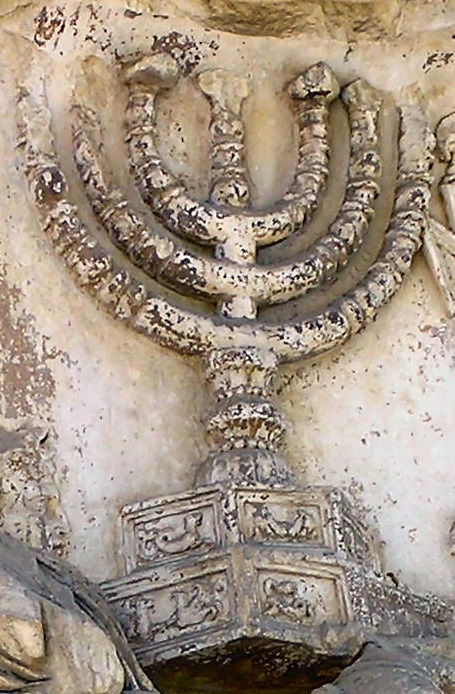
Rome knew how to kill a government. It was one of its better tricks.
In 70 CE Roman soldiers broke Jerusalem, burned the Temple, carried off its treasures, and eventually carved the loot onto the Arch of Titus. There is the menorah, still being marched through Roman stone two thousand years later. Imperial propaganda has enjoyed worse shelf lives.
This should have finished the job.
The Temple was not merely a large synagogue with spectacular real estate. It was altar, treasury, pilgrimage centre, political institution, and headquarters of a hereditary priesthood. Sacred authority had an address. Priesthood had a bloodline.
Rome burned the address.
Judaism survived because an older struggle had already begun moving authority somewhere armies have always had trouble reaching: into literacy, interpretation, schools, courts, and the heads of ordinary people.
A priest was born.
A scholar could be made.
That difference cracked the old world open.
The Hebrew Bible had never been entirely comfortable with human kings. In 1 Samuel 8, Israel asks for a king so it can be “like all the nations.” Samuel answers with an anatomy of the state: the king will take sons, daughters, fields, vineyards, animals, and labour. The people ask for sovereignty and receive a tax assessment.
Deuteronomy allows a king but practically hangs warning labels from his crown. Do not multiply horses. Do not multiply wives. Do not pile up silver and gold. Read Torah constantly so ruling never becomes an excuse to imagine oneself above the law. Jewish kingship enters history already under suspicion.
The Hasmoneans demonstrated why.
The Maccabean revolt began as an anti-imperial rising against Seleucid coercion and sacrilege. The author of 1 Maccabees praises Rome as a powerful polity without a king, governed by council, whose magistrates do not wear crowns or purple. The early Hasmonean settlement likewise stopped short of kingship. Simon became leader and high priest only “until a trustworthy prophet should arise” (1 Macc. 14.41). Authority had been installed. Final authority had not.
Then the descendants found the crown.
Revolutions do this sometimes. They break into the palace, denounce the machinery, sit in the chair, and discover the upholstery is really rather comfortable. By Alexander Jannaeus, the Hasmonean ruler was both king and high priest. Crown pressed against crown. The anti-imperial revolt had produced a priestly monarchy, and the monarchy began murdering its own opposition. Josephus records civil war, executions, and hundreds of Pharisaic opponents crucified while Jannaeus feasted.
Old monopolyThe priest possessed lineage, altar, office, and soldiers.
Rival authorityThe interpreters claimed inherited tradition could bind even the man at the altar.
Popular sanctionThe people had etrogim—and enough knowledge to know when to throw them.
During Sukkot, Jannaeus deliberately rejected the popular water-libation tradition associated with Pharisaic interpretation. The dispute was not really about pouring water. It was about whether inherited oral tradition could bind the man standing at the altar. The crowd answered by pelting the king and high priest with citrons.
Constitutional crisis by fruit.
The scene matters because the priest possessed the Temple, the office, and the royal title. Yet ordinary worshippers believed they possessed enough knowledge of the tradition to judge him. Sacred authority had begun escaping hereditary office.
Josephus preserves the social split bluntly. The Sadducees, he reports, persuaded chiefly the rich, while the Pharisees held influence with the multitude (Antiquities 13.298). Josephus was an aristocrat, survivor, Roman client, and talented arranger of inconvenient memories. This is not census data. The political problem visible through his baggage is still extraordinary: a ruler could inherit sacred office, acquire a crown, command soldiers, and lose legitimacy to teachers.
Later rabbis remembered the Temple elite with even less affection. Pesachim 57a curses the great priestly houses whose sons controlled offices and whose servants beat people with clubs.
Not neutral reportage.
Class-anger archive.
Rabbinic traditions make Shimon ben Shetach the institutional mechanic of the Pharisaic counter-revolution. Under Salome Alexandra the crown survived, but Shimon rebuilt legal authority around Torah, court, testimony, and scholarly procedure. The ruler no longer stood as the source of law. The ruler was placed beneath it.
This was a counter-revolution against a captured revolution. The Maccabees had thrown off empire. Their descendants rebuilt empire in miniature. Pharisaic Judaism attacked the capture by moving decisive legitimacy out of the ruler’s body.
One model put authority into a sovereign body. The other taught children to carry it in their heads.
Literacy was the real weapon.
A hereditary priestly class reproduces through birth. A scholarly class reproduces by teaching. Rabbinic tradition delights in the inversion. Hillel becomes the poor labourer who spends half his daily wage simply to enter the study house. Akiva begins as a shepherd. Rabbi Yehoshua works with his hands. These stories are not employment files from ancient Judea. They are political myths about what kind of person may possess Torah.
A shepherd can become the authority.
The schoolhouse turns the counter-elite struggle into a social technology. Pirkei Avot imagines the child moving from Scripture at five to Mishnah at ten. Bava Batra 21a remembers Joshua ben Gamla establishing teachers throughout towns so children could learn systematically.
Ancient Judea did not suddenly achieve universal literacy. That would be a lovely story and terrible history. David Goodblatt and other historians have given ample reason to distrust smooth rabbinic narratives about their own institutional ancestry. The important change is the ideal and the infrastructure behind it. Sacred knowledge becomes teachable beyond hereditary office. Interpretation can be reproduced horizontally. A network of teachers weakens monopoly by place; a literate public eventually weakens monopoly by blood.
Then Rome burned the Temple.
Too late.
The technology had already escaped. A dynasty can be killed. An altar can become rubble. A school can reopen somewhere else. A ruling can travel. A question can cross an empire and return carrying an answer.
The rabbis eventually became an establishment. Institutions are greedy little animals. Rabbinic Judaism developed courts, hierarchy, discipline, exclusions, and every other piece of furniture a successful insurgency eventually drags into its office.
But the captured revolution preserved its weapon.
Study remained sacred. Argument remained legitimate. Minority opinions were copied beside majority rulings. Teachers produced students who produced teachers. Across Christian and Islamicate empires, Jewish communities rebuilt courts, schools, charities, calendars, and legal networks beneath somebody else’s sovereignty.
Not freedom. Not innocence. Something stranger.
The emperor might own the sword without owning Sinai.
For nearly two thousand years Judaism became extremely good at living as a counterculture inside larger civilizations: borrowing their languages and philosophy, arguing with them, surviving them, sometimes serving them, sometimes resisting them, and refusing complete absorption.
Modern Jewish nationalism often reads those two thousand years as failure. Exile. Weakness. Waiting. Jewish history apparently spends centuries pacing the railway platform until somebody finally hands it a flag, an army, and customs forms.
There are reasons that story became persuasive. A responsum cannot stop a pogrom. A charity fund cannot defeat an army. Foreign protection has a nasty historical habit of disappearing precisely when required.
But another history sits beside it. One of Judaism’s greatest political inventions was learning how to remain a people without allowing the territorial state to become the sole container of the people. Modern Zionism emerged through European nationalism and reversed part of that wager. Territory, demographic power, military force, and sovereign statehood moved back toward the centre.
This was not Judaism finally becoming political. It was one historically specific answer to the Jewish political problem. From the perspective of the older revolution, it is almost an inversion: Pharisaic-rabbinic Judaism broke the monopoly of sacred territory and hereditary sovereignty; modern nationalism recentered territory, coercive state power, and ethnonational sovereignty.
The Maccabees had already supplied the warning. An anti-imperial revolution can capture imperial machinery and begin reproducing what it defeated. A modern Jewish state does not receive an exemption from the older Jewish refusal to let a human institution pretend it has become G-d.
Yehuda Ashlag saw the nationalist escape hatch. His communist Kabbalah rejected a socialism that prohibited exploitation within one nation while permitting that nation to exploit another. Justice had to become international and anti-imperial or it was merely selfishness enlarged to national scale.
Somewhere here Judaism’s old messianic optimism wanders into modern radicalism. Marx secularized redemption into history. Jewish socialists carried Exodus into labour halls. The IWW later called on workers to build the new society within the shell of the old. Ashlag imagined mutual responsibility as a material order rather than a charitable mood.
Tikkun olam need not mean polishing the existing world until empire feels ethical.
Repair can mean building another world inside this one.
Judaism has done that before.
That may be why it is still here.
Rome could burn the Temple. The harder problem was that Judaism had taught people how to carry the revolution out in their heads.
Sources and further reading
Ashlag, Yehuda. The Writings of the Last Generation. Mid-twentieth century.
Goodblatt, David. “The Place of the Pharisees in First Century Judaism: The State of the Debate.” Journal for the Study of Judaism, vol. 20, no. 1, 1989, pp. 12–30.
Josephus. The Antiquities of the Jews. Book 13. Translated by William Whiston. Sefaria.
1 Maccabees. Chapters 8 and 14.
Mishnah Sukkah 4:9; Pirkei Avot 5:21; Babylonian Talmud, Pesachim 57a, Yoma 35b, Ketubot 62b, Berakhot 28a, and Bava Batra 21a. Sefaria.
The Holy Scriptures. 1 Samuel 8 and Deuteronomy 17:14–20.