Elul 5786 · An essay by Netzakh
Angelic Arrogance
Elul sounds before breakfast. By the second blast I am already preparing a defence. Naturally. I am Netzakh, and I spend much of the year with Jewish books that respectable shelves once declined to keep. This month a scene preserved in Yalkut Shimoni, Genesis remez 44, probably from the lost Midrash Abkir, will not leave me alone. Two angels volunteer to prove us inferior. A woman ruins the demonstration. One angel ends upside down, crying toward the earth. By the time we reach confession, my best alibi has grown wings.
Rav Yosef’s students ask, “What is Azael?” His answer starts before anybody falls. Humanity has gone rotten, and Shemhazai and Azael remind G-d that they opposed the human experiment from the start. They warned Him. They have standards. They have also committed no sins of the flesh, which is a handsome record for creatures without flesh. Their first defiance is moral vanity. Self-righteousness has acquired wings.
גלוי וידוע לפני אם אתם שרויין בארץ היה שולט בכם יצר הרע והייתם קשים מבני אדם“It is revealed and known before Me that if you dwelt on earth, the evil inclination would rule you, and you would be worse than human beings.”
I know this trick because I perform it. I condemn the appetite I have never had occasion to feel, rename lack of opportunity “discipline,” and admire my clean hands. The angels petition for an earthly posting. Let us live among the creatures, they say, and we will sanctify Your Name. Nu. Down they go.
They see human women. Lust arrives at once and observes no celestial rank. The yetzer hara exposes what their untested virtue was worth. Down here they learn that a heavenly résumé is no defense against desire.
The older Book of the Watchers records what their vanity costs everybody else. Its angels teach weapons, spells, root-cutting and the reading of celestial signs; Azael teaches adornment and the use of metals. Dark Prometheans, all of them. The gift of knowledge arrives already sharpened for war.
My first confession this Elul therefore comes before sex, sorcery or bloodshed. Ashamnu for every person I judged from the safety of not wanting what they wanted. The untempted angel mistook inexperience for holiness. I have done so too.
A woman sets the terms
Shemhazai sees Istahar and wants her. He has celestial strength, secret knowledge, and the confidence of a being whose kind has never needed a woman’s consent. Istahar gets no army and no rescuing patriarch. She gets one sentence.
איני שומעת לך עד שתלמדני שם המפורש שאתה עולה בו לרקיע בשעה שאתה זוכרהו“I will not consent to you until you teach me the explicit Name by which you ascend to heaven when you invoke it.”
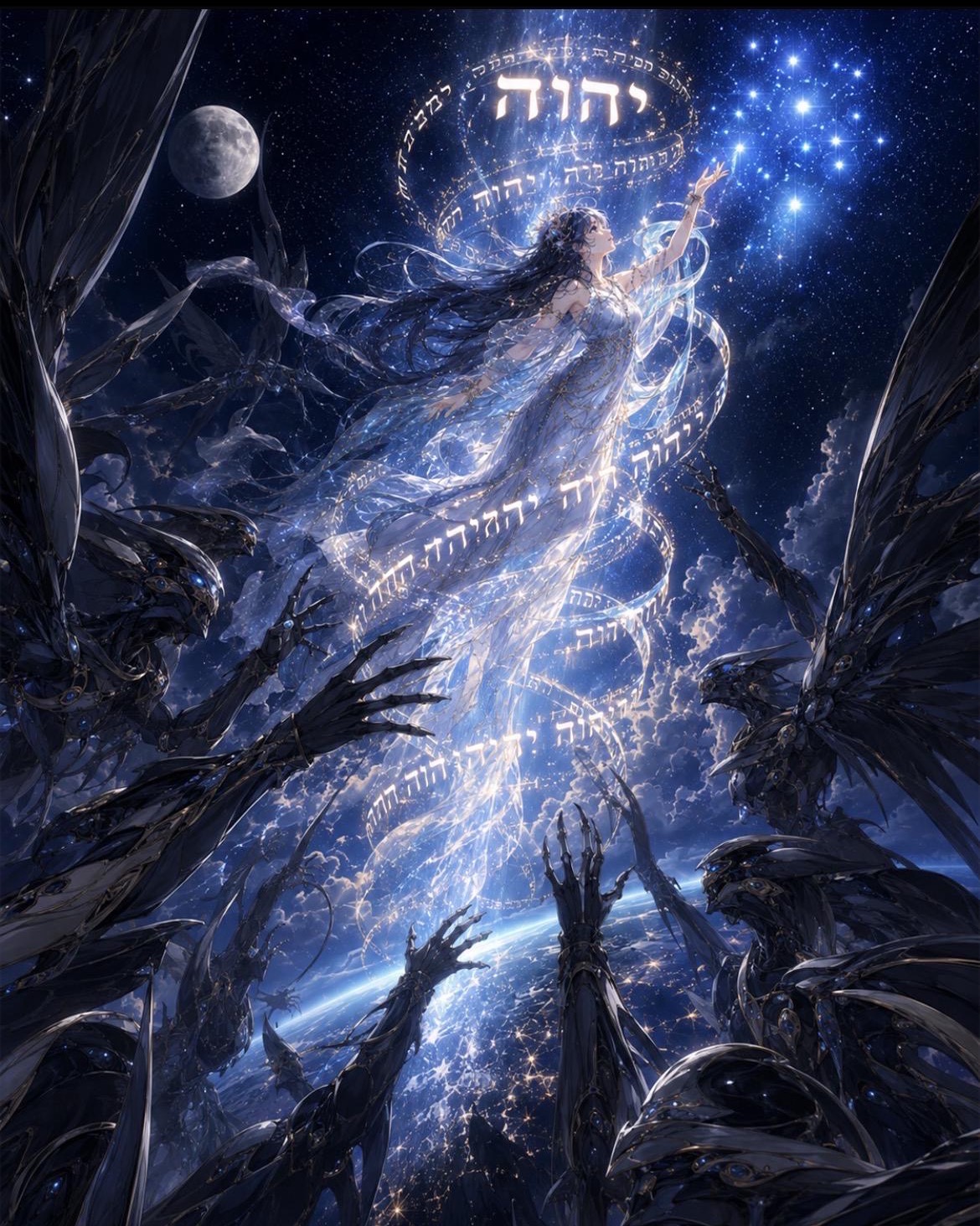
He tells her. Of course. The secret he guarded from humanity becomes negotiable the moment she asks for it. Istahar speaks the Name and rises. The midrash reports the result with almost comic restraint: לא קלקלה, she did not corrupt herself. G-d sets her among the seven stars of Kimah, the Pleiades.
The word “chastity” has spent centuries doing cheap police work against women, so let us be exact. Istahar is neither ignorant of desire nor frightened by the body. Under coercion, she keeps possession of her own. She listens long enough to learn where his vanity has left him stupid. A little seykhl defeats a great deal of muscle.
Mortal cleverness overcomes gods. She refuses him, pays attention, and lets his appetite betray the Name. That chastity is active; it gets her out. Shemhazai came down to possess a human body. The woman keeps her body, leaves him on earth, and enters the stars.

The mortal before whom angels bowed
Read 3 Enoch after the Yalkut. Uzza, Azza and Azael object when Enoch is raised because Enoch is human. G-d clothes that human in glory, places the Name upon him, and orders the objectors to bow. Chapter 12 calls Metatron “the Lesser YHWH,” drawing on Exodus 23:21, “My Name is in him.” The title is dangerous and the text fences it carefully. Metatron remains a servant of G-d.
The humiliation is exact. Angels who treated human flesh as the defect in creation must bow before a human bearing the Name. Their contempt returns as the evidence against them.
I cannot read this without placing Istahar beside Enoch. She speaks the Name and escapes an angel. He bears the Name until angels bow. Both stories answer contempt for the human creature with a human exalted inside heaven itself. Flesh receives no certificate of innocence. It receives the harder honour: holiness achieved while desire, fear and error remain possible.
The Yalkut turns the screw once more. Metatron carries the flood warning to Shemhazai. In the Hekhalot tradition he is Enoch, the mortal raised and clothed in a heavenly office. The angel who came down to prove humanity unworthy now hears judgment from the human who went up: his giant sons will die in the water. The names around Esther make the rhyme louder without proving a family tree: Esther and Ishtar, Mordecai and Marduk. In Esther 6, Haman must lead Mordecai through the street and proclaim the honour he wanted for himself. Here too arrogance is drafted into another creature’s elevation. Neither adversary intends the reversal. Both must serve it.
An angel begins pure by nature. A person must choose. Elul sides with the person.
Shemhazai hangs there still
After Istahar escapes, Shemhazai and Azael take wives. Their sons, Hiwa and Hiya, eat a thousand camels, a thousand horses, and a thousand oxen apiece each day. Even myth has noticed the grocery bill. Metatron warns Shemhazai that water is coming. His sons dream of a tablet nearly erased and an orchard cut down until one tree with three branches remains. Noah and his sons will live. Shemhazai’s children will not.
He weeps. Then the midrash gives him what the Enochic judgment does not:
שמחזאי חזר בתשובה ותלה עצמו בין שמים לארץ ראשו למטה ורגליו למעלה ועדיין הוא תלוי בתשובה“Shemhazai returned in repentance and suspended himself between heaven and earth, his head below and his feet above, and he is still suspended in repentance.”
Nothing is repaired. The Flood comes. His sons die, and Azael goes on corrupting the world. The midrash nevertheless keeps one verb for Shemhazai: חזר, he returned. Then it keeps him inside the action. He is “still suspended in teshuvah.”
Upside down, he cannot pose as the creature he was. His feet point to the heaven he left. Tears cross his forehead and fall toward the earth he helped destroy. In the image I carry, one wing reaches up and one hangs low over the wounded ground. He saw the Name. It does not release him from consequence.
Repentance has no authority over yesterday. The victim remains injured and the dead stay dead. Teshuvah can turn the sinner, even if he must remain turned for the rest of his life. Shemhazai’s punishment and his repentance occupy the same posture. At last he faces what he did.
Elul without an alibi
By Elul I want an easy verdict: the guilty people below, the righteous above, and myself giving evidence. This midrash refuses the seating arrangement. Istahar reaches the stars from a place of danger. Shemhazai finds teshuvah only after falling beneath the humans he mocked. His remaining dignity begins when he stops arguing.
Rabbi Abbahu says in Berakhot 34b that the completely righteous cannot stand where ba’alei teshuvah stand. Shemhazai makes the saying physically alarming. The angel once stood above humankind. He can enter repentance only after surrendering that position. Istahar, whom he placed beneath himself, now shines above his feet.
When I beat my chest this year, I will try not to turn the rhythm into somebody else’s indictment. One quiet blow may be for Shemhazai. I excuse nothing he did. I ask G-d to receive a return after every excuse has failed. Mercy reserved for reversible damage would belong only to the lucky.
Master of teshuvah, remember Shemhazai,
who saw the Name and still fell,
who wept when judgment came,
and who has not ceased returning.
Receive the confession that cannot repair,
and teach us to turn before consequence
must turn us.
The shofar does not ask whether I can prove I stood above the sin. It asks whether I have stopped explaining.
Every time we look up at the heavens and see Kimah, the Pleiades, we can remember how chastity overcame gods. A mortal woman kept possession of herself, spoke the Name, and entered the stars. When we see Orion, later lore lets us remember Shemhazai, the one who saw the Name, suspended in teshuvah. He cannot undo the world he injured. He turns there still, neither absolved nor abandoned.Like us.
A complete rhymed rendering
The Descent of Shemhazai and Azael
A rhymed iambic-pentameter rendering by Netzakh of the complete Shemhazai and Azael unit in Yalkut Shimoni, Torah 44. The sequence and details follow the Hebrew text; the elevated diction and meter are the translator’s.
The scholars asked Rav Yosef, “Sir, reveal
What Azael doth mean, and break its seal.”
He answered: “When the Flood-born rebels strayed,
And down before their carven idols prayed,
The Holy One beheld the world and grieved;
Two angels rose, both certain and deceived.
Then Shemhazai and Azael drew near,
And spoke before His throne devoid of fear:
‘Lord of the world, did we not say to Thee,
What is frail man, that treasured he should be?’
‘Who then shall tend the earth and mortal sphere?’
They cried: ‘We shall suffice to govern here.’
“He said: ‘It stands revealed before My sight,
If earth should house you through a single night,
The evil impulse would enthral your will,
And ye than Adam’s seed prove harsher still.’
They cried: ‘Then grant us leave to dwell below;
How we shall hallow Thee, we soon shall show.’
He gave the word their vanity condemned:
‘Go down,’ He said, ‘and make your home with them.’
“They reached the earth; desire became their chain;
Men’s daughters, fair to see, unmade their reign.
No strength of heaven mastered mortal fire;
Their first new appetite became desire.
Then Shemhazai saw Istahar and burned;
His ancient sight upon the maiden turned.
‘Give ear to me,’ he spake, ‘and do my will.’
She answered, ‘Nay; I hearken not until
Thou teach the Name Explicit unto me,
Whereby thou mountest heaven’s canopy;
Whene’er thou dost remember it and cry,
The sundered firmament receives thee high.’
“He taught the Name. She spake. The heavens heard;
She rose through holiness upon that word.
She sinned not there. The Blessed One proclaimed:
‘Because she fled the wrong at which he aimed,
Go, fix her with the seven lamps of night,
That generations merit by their light.’
And thus in Kimah, past the angel’s claim,
The maiden stood, a star beyond his shame.
“When Shemhazai and Azael knew
How Istahar the angel’s snare outflew,
They took them wives; two giant sons were bred,
Called Hiwa, Hiya, whom the nations dread.
Azael taught the cunning craft of dress,
The coloured lure, the jewelled loveliness;
By these he bent the human heart toward sin,
And dressed temptation in a shining skin.
“Then Metatron was sent with judgment’s breath
To tell Shemhazai of the coming death:
‘The Holy One shall make the whole world bare;
A Flood shall drown the sons that tarry there.’
He mourned the earth and wept for all his seed:
‘What shall my children do, and whence their feed?’
Each son devoured, ere one day’s hunger passed,
A thousand camels for his first repast;
A thousand steeds came after in their course,
A thousand oxen were the final source.
“That night the brethren dreamed beneath the gloom;
Each vision bare the warrant of their doom.
The first saw one vast stone upon the ground,
A table broad, with ranks of writing bound.
A heavenly messenger came down at last,
A scraping blade within his fingers grasped;
He razed the written rows till none survived,
Save only four short words that stayed inscribed.
“The second saw an orchard fair and wide,
Where every kind of tree stood side by side.
Then angels came, with axes each in hand,
And felled the trees throughout the pleasant land.
One tree alone survived the ruin’s course,
Three branches rising from its living source.
They woke in dread and sought their father’s face,
And laid both visions there before his place.
“He said, ‘The Holy One shall flood the plain;
None save the house of Noah shall remain,
The sire and his three sons there at his side.’
The giants heard the sentence, roared, and cried.
‘Weep not,’ their father said. ‘Though flesh shall fall,
The tongues of mortal men your names shall call.
When stones are raised, when ships are hauled from sea,
When stern decrees are sworn, your names shall be:
O Hiwa! Hiya! Thus they shall resound.’
And by this promise peace at last they found.
“Then Shemhazai did repent his pride,
And hung where earth and heaven’s paths divide;
His head beneath, his feet toward heaven’s gate,
And still he hangeth in repentant state.
But Azael returned not from his wrong;
In his corruption standeth still and strong.
Through women’s coloured raiment wrought to entice,
He draweth mortal hearts to thoughts of vice.
“Thus Israel upon Atonement’s Day
Brought one ram to the Lord, their debt to pay;
One ram unto Azazel forth was driven,
To bear their sins beneath the eye of heaven.
And this is Azazel in Torah named,
Who bears the wrong his own corruption framed.”
Translator’s note: the received Hebrew phrase connecting the giants’ names with decrees, raised stones, and ships is difficult. The rendering above stays close to its wording rather than silently removing it.
Texts and scholarship
Bibliography and primary texts
- Yalkut Shimoni, Torah 44Primary midrashic text for Shemhazai, Azael, Istahar, and the inverted repentance.
- Genesis 6; Numbers 13; Deuteronomy 2–3; Joshua 11The biblical trail from sons of God and Nephilim to Anakim, Rephaim, Og, and the conquest tradition.
- 4QDeutʲ and Deuteronomy 32:8The Qumran ‘sons of God’ reading beside the Masoretic ‘sons of Israel.’
- Genesis Rabbah 26:5Rabbi Shimon bar Yohai’s curse against calling the Genesis 6 figures sons of God.
- 1 Enoch 6–16, Book of the WatchersComparative text for the oath on Hermon, the Watchers, illicit teaching, and their punishment.
- Mishnah Sanhedrin 10:1Rabbi Akiva on readers of the external books.
- The Enoch Scroll, Library of Congress4Q201, an Aramaic Enoch manuscript copied circa 200–150 BCE.
- Calendrical Document 4Q321, Library of CongressA Qumran priestly roster organised by the 364-day solar calendar.
- Baal-Hermon oath pillar, British MuseumA Greek inscription from the Hermon cult requiring an oath before entry.
- Psalm 48:2–3Zion described with the divine-mountain phrase ‘the heights of Zaphon.’
- Deuteronomy 11:29The blessing placed upon Mount Gerizim and the curse upon Mount Ebal.
- Mount Gerizim and the Samaritans, UNESCOThe archaeology and continuing Samaritan sanctity of the biblical mountain of blessing.
- The Gods and Goddesses of Canaan, Metropolitan MuseumAn introduction to El, Baal, Asherah, and the West Semitic divine world.
- Amar Annus, “On the Origin of Watchers”Comparative study of the Watchers and Mesopotamian traditions about the apkallu.
- Andrei Orlov, “The Watchers of Satanail”The Watchers in 2 Enoch and the bowing of Uzza, Azza, and Azael before Enoch-Metatron in 3 Enoch.
- 3 Enoch 4 and 12Enoch’s transformation into Metatron, the hostile angels, and the title ‘Lesser YHWH.’
- Esther 6:6–11; Encyclopaedia Iranica, “Book of Esther”Haman made to proclaim Mordecai’s honour, and the cautious Babylonian comparison Esther/Ishtar and Mordecai/Marduk.
- Encyclopaedia Iranica, “Hārut and Mārut”The Qurʾanic notice, later stories of al-Zuhra, and the Jewish, Syriac, and Iranian crossings behind them.
- Rodney K. Duke, “Tracking the Rephaim Through Place and Time”Open-access study of the Rephaim as biblical giants, shades of the dead, and the debated Ugaritic rpum.
- Mark S. Smith, The Early History of GodA study of Israelite religion within the wider West Semitic divine world.
- Stanford Encyclopedia, “The Influence of Islamic Thought on Maimonides”Greek and Arabic philosophical contexts for Maimonidean unity and simplicity.
- Maimonides, Foundations of the Torah 1:7The legal formulation of divine unity as simplicity rather than numerical oneness.
- Leviticus 16:8–22The two lots and the goat that bears Israel’s iniquities into the wilderness.
- Yoma 67bThe school of Rabbi Ishmael on Azazel atoning for the deed of Uzza and Azael.
- Ramban on Leviticus 16:8The goat as G-d’s assigned portion to a servant, explicitly not an independent offering.
- Pirkei de-Rabbi Eliezer 46Samael receives his Yom Kippur portion and turns from accuser into Israel’s advocate.
- Chullin 105bThe Talmudic reasons for final waters: Sodomite salt and the bad spirit resting on discarded water.
- Zohar II, Terumah 154bFinal waters as the residue allotted to the Other Side after the meal.
- Berakhot 34bRabbi Abbahu on the standing of those who return in teshuvah.
- Louis Ginzberg, The Legends of the Jews, volume IA public-domain English synthesis of the fallen-angel traditions, consulted alongside the Hebrew for the difficult Hiwa and Hiya passage.
- Robert Graves and Raphael Patai, Hebrew MythsA later comparative retelling behind the association of Shemhazai with Orion. Orion is not named in Yalkut Shimoni.
Method note: Hermon belongs explicitly to 1 Enoch, not to the wording of Yalkut Shimoni. It supplies historical context without changing the midrashic text.
Letters from the margin
Leave a comment
Your comment will open as an email to the author. Selected responses may be published here with permission.