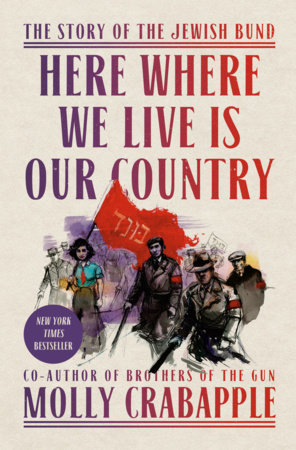
Molly Crabapple’s book is not a neutral book, and it would be worse if it were. Neutrality, in the history of the Jewish Labor Bund, too often means burial with better manners. Here Where We Live Is Our Country is a fierce, illustrated popular history of a movement pushed into the margins by the great meat grinders of modern Jewish memory: Zionism, Bolshevism, fascism, Stalinism, liberal amnesia, and the simple fact that so many of its builders were murdered. Crabapple does not pretend to float above the wreckage. She climbs down into it, pockets full of colour, and comes back with a book that is part history, part family reckoning, part political exhumation.
Reading this as a graduate student of history, I expected the usual danger signs. A famous artist turns to family history. A vanished political movement returns as a present-tense weapon. The prose warms up, the archive starts singing, and suddenly everyone in the past knows exactly what the present needs. Crabapple sometimes walks near that cliff. She knows it. Yet the book survives because its romance is not lazy. It is document-hungry, materially alert, and unusually attentive to institutions. The Bund is not rendered as a floating mood of Jewish leftism. It is built from unions, newspapers, schools, youth movements, women’s organisations, workers’ clubs, self-defense networks, sanatoria, prisons, secret presses, and arguments so bitter they could curdle soup.
The book’s central achievement is to make the Bund legible as a political alternative rather than a defeated footnote. The famous slogan, “Here where we live is our country,” becomes the axis of the narrative, but Crabapple refuses to reduce doikayt to decorative nostalgia. Hereness, in her telling, is not passive attachment to place. It is a discipline. Stay here. Organise here. Strike here. Teach children here. Defend workers here. Refuse the fantasy that dignity must be imported from elsewhere or ratified by a state. In this sense, the Bund was not merely anti-Zionist; it was anti-eviction as a political philosophy. It rejected assimilation into host nations, but also rejected the idea that Jewish life could be saved only by becoming sovereign over another people.
“A movement is not proved only by its manifestos. It is proved by its lungs, shoes, paper routes, meeting minutes, and sick children sent into sunlight.”
Crabapple’s illustrations are not ornament. They are argument. They return bodies to political history, and this is no small thing. The face, the coat, the window, the gun, the street corner, the worker’s hand, the frightened child: each image fights the bureaucratic flattening that mass death leaves behind. Her art catches what the prose insists on, namely that Jewish socialism was not only a doctrine but a texture of life. One feels the crowded rooms, the posters, the barricades, the vulgar little miracles of committees and kitchens. Crabapple understands that a movement is not proved only by its manifestos. It is proved by its lungs, shoes, paper routes, meeting minutes, and sick children sent into sunlight.
That is why the Medem Sanatorium passages are so important. The Bund’s politics were not just made in revolt; they were made in care. Poor children threatened by tuberculosis encountered not charity from above but a miniature republic of fresh air, secular Yiddish education, self-government, and beauty. Crabapple’s phrase “love and grit” condenses the point almost too neatly, but it works because the institution itself was a kind of answer to despair. A movement that can build a children’s sanatorium has already said something serious about power. Not speeches. Beds. Milk. A newspaper written by children. The politics of survival without surrender.
The battle scenes deserve special praise because Crabapple refuses the antique fraud of clean heroism. Revolution and resistance here are not marble tableaux. They are panic, error, courage, argument, bad timing, broken plans, and the animal mathematics of who has a pistol and who has a door. When she writes “We broke open the world,” the sentence carries the intoxication of 1905 without dissolving into propaganda. The later sections on Warsaw and the ghetto revolt are even stronger. Crabapple gives us the committees, smuggling, weapons, couriers, factional distrust, and the awful fact that solidarity has limits even among comrades. She writes against the postcard version of resistance. Good. Let the postcard burn.
Her Holocaust writing is among the book’s most disciplined work because it rejects sanctified suffering. “Death is not glorious” is the sentence that should haunt the reader. Crabapple does not turn murdered Bundists into clean martyrs for a usable politics. She shows the shrinking choices, the starvation, the ideological fracture, the useless bravery, the necessary bravery, and the sickening knowledge that no political tradition is vindicated by being killed. That is the book’s hardest defense against its critics. The Bund was defeated. Yes. But defeat is not refutation. Murder does not make the murderer right. History is not a tribunal where the survivor automatically inherits the truth.
The book is also valuable because it restores contingency to Jewish modernity. Too much public Jewish history is written as if the twentieth century had only two exits: assimilation or Zionism, disappearance or statehood. Crabapple reopens the third door, and behind it is noise: Yiddish, socialism, labour militancy, women speaking from platforms, children printing newspapers, workers refusing bosses, revolutionaries arguing with other revolutionaries, Jews fighting as Jews and workers without agreeing to become either a museum people or a nation-state in waiting. The slogan “We are not foreigners” lands here not as innocence but as defiance. It names a claim to belonging that European nationalism, antisemitism, and later postwar certainties all tried to erase.
The obvious criticism is that Crabapple writes with present political fire in her mouth. True. She does. But there is a difference between tendentious history and situated history. Crabapple’s book is not a monograph pretending to have no pulse. It is a popular history with a thesis, a memory politics, and a visible moral stake. That will irritate readers who prefer their Jewish dead safely arranged in consensus language. Let them be irritated. The more serious question is whether the book gives readers enough historical texture to argue back. It does. It names factions, failures, rivalries, compromises, betrayals, and delusions. It does not save the Bund by making it pure. It saves it from being made irrelevant.
The result is an extraordinary recommendation, especially for readers interested in Jewish political history, labour movements, diaspora nationalism, anti-fascism, Yiddish culture, and the unresolved war over what Jewish safety is supposed to mean. Crabapple’s prose has teeth, her art has voltage, and her history has the rare virtue of making the past feel unfinished without making it feel fake. This is not a perfect book. Perfect books are usually embalmed before publication. This one lives. It sweats. It quarrels. It insists that archives are not cemeteries. They are weapons caches, and sometimes a child’s drawing, a Bundist song, or a painted girl breaking a window can still teach the living how to stand.